What is Augmentative and Alternative Communication (AAC)?
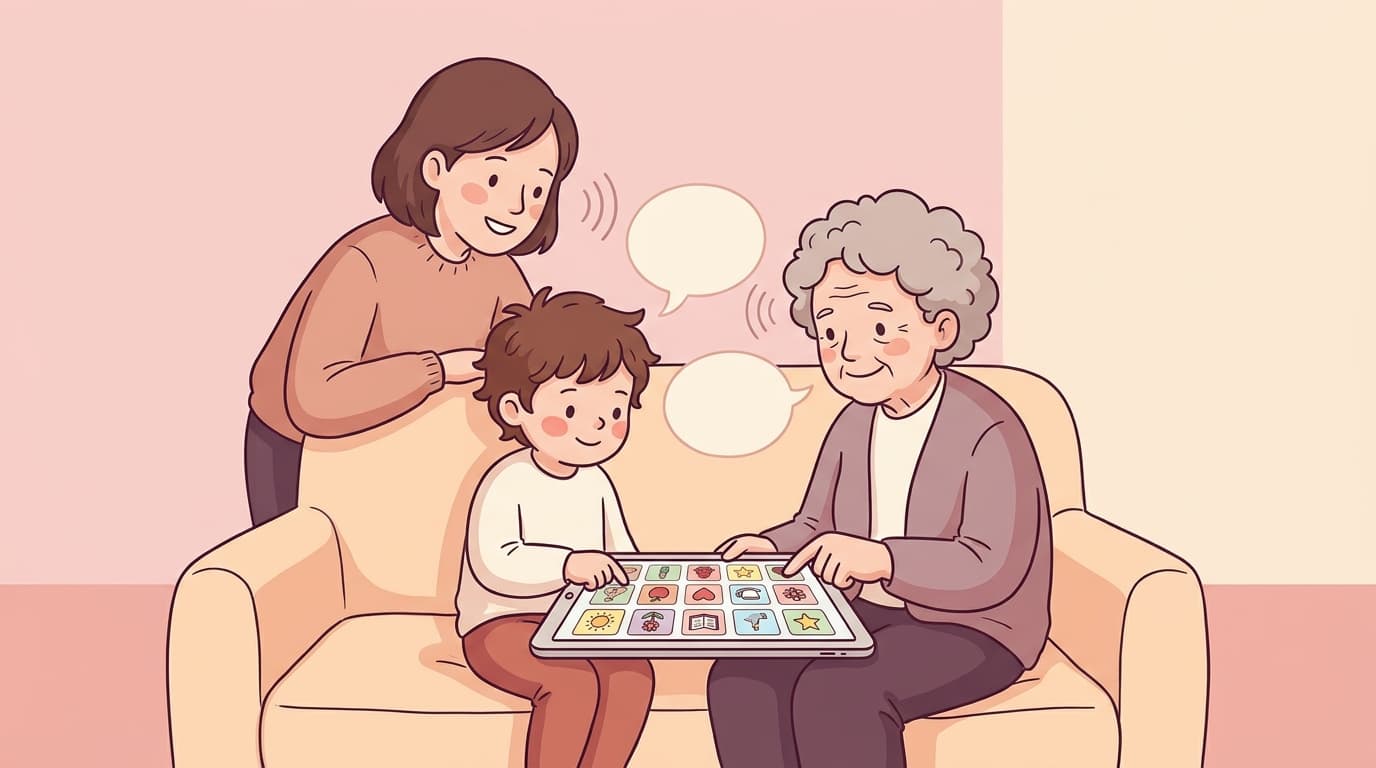
Many children and adults cannot express their thoughts reliably through spoken words. That does not mean they have nothing to say, or that they do not understand what is happening around them. Augmentative and Alternative Communication (AAC) bridges that gap. It covers the tools, strategies, and supports that let a person communicate whenever speech is absent, limited, tiring, or hard for others to understand.
Who AAC is for
AAC is not limited to a single age group or diagnosis. It supports both children and adults living with:
- autism spectrum differences
- cerebral palsy or motor speech disorders (such as apraxia of speech)
- developmental language delay
- aphasia after a stroke or brain injury
- progressive neurological conditions such as ALS/MND or Parkinson's disease
- temporary speech loss, for example during recovery or intensive care
For some people, AAC is a bridge while spoken language develops or recovers. For others, it is a lifelong voice, or a backup used when speech becomes fatiguing. Every one of those paths is valid.
Two myths worth clearing up right away
"Will AAC stop my child from learning to talk?" Research consistently shows the opposite. Using AAC does not delay or prevent speech development; in many cases, it supports gains in both spoken words and language comprehension. When a person experiences that communication actually works and brings a response, their desire to communicate grows.
"Does a person need to master picture cards or reach a certain age first?" No. Modern speech-language therapy guidelines emphasize presuming competence: there are no prerequisites for trying AAC. A young child, a nonspeaking teenager, or an adult recovering after a stroke does not need to pass matching tests before being given access to a robust voice.
The main kinds of AAC
Clinicians group AAC into two complementary categories:
Unaided AAC. Gestures, facial expressions, pointing, eye gaze, vocalisations, and sign language. Always available and requires no equipment.
Aided AAC. Picture symbols, printed communication boards or books, and speech-generating apps on a phone or tablet that speak selected words and sentences aloud.
Real communication is multimodal. A child or adult might shake their head for "no", point at a nearby cup, and use an AAC app to share a feeling, ask a question, or explain what hurts.
How to start: evidence-based principles
Starting does not mean drilling flashcards or teaching a hundred nouns in a week. Speech-language pathologists recommend four core habits:
- Start with high-frequency core words, not just requests. Words like "more", "stop", "no", "help", "want", "like", "go", and "finished" work in almost every room and situation. Make sure the person can refuse, protest, comment, and ask questions, not only ask for food or toys.
- Model the system yourself (Aided Language Input). Tap key words on the board while you speak naturally ("Let's go outside", "You like that"). Do not force the learner to imitate you. Just as babies hear thousands of spoken words before saying their first, AAC learners need to see people actually using the board in real life.
- Pause and give generous wait time. Composing a message on a board takes motor and language processing time. Count silently to five (or longer for someone with motor fatigue) before jumping in or guessing.
- Respond meaningfully to every attempt. Even an exploratory tap teaches cause and effect. If a child taps "water", respond warmly ("You said water! Here is a sip"). If they tap something unavailable right now ("park"), still honour the message ("You're thinking about the park! We can go after lunch").
AAC for adults
Adults who lose speech suddenly or gradually have distinct priorities. Respectful, uncluttered adult layouts (clear pictograms or text rather than childish cartoons), quick medical and self-introduction phrases, and fast access to personal vocabulary matter immediately. For adults with progressive conditions, voice preservation or voice cloning while speech is still intelligible lets them keep speaking in a voice that genuinely sounds like themselves.
Why native language and natural voice matter
Every person deserves to communicate in the language spoken around their own table, in a voice that sounds human and reflects who they are. Too many families and adults still have to settle for robotic voices or tools that ignore their grammar and daily culture.
Aron began in Georgia alongside our founding clinical co-authors, clinics Phoenix and Helios, and has grown into an international multilingual AAC app created with clinical partners overseas. Today Aron speaks English (with 6 regional accents), Georgian, Serbian (Latin and Cyrillic), Russian, and French, with dedicated Child and Adult modes, expressive voices, voice cloning, and native grammar support.
One last thought
The most common regret families and clinicians hear is waiting too long to begin. Starting AAC is never giving up on speech. It is giving a child or adult dignity, autonomy, and a voice today.
Sources
- American Speech-Language-Hearing Association (ASHA). Augmentative and Alternative Communication (AAC) Practice Portal.
- Millar, D. C., Light, J. C., & Schlosser, R. W. (2006). The impact of augmentative and alternative communication intervention on the speech production of individuals with developmental disabilities: A research review. Journal of Speech, Language, and Hearing Research, 49(2), 248-264.
- Brady, N. C., et al. / National Joint Committee for the Communication Needs of Persons with Severe Disabilities (2016). Communication services and supports for individuals with severe disabilities: Guidance for assessment and intervention. American Journal on Intellectual and Developmental Disabilities, 121(2), 121-138.
- Beukelman, D. R., & Light, J. C. (2020). Augmentative & Alternative Communication: Supporting Children and Adults with Complex Communication Needs (5th ed.). Paul H. Brookes Publishing.